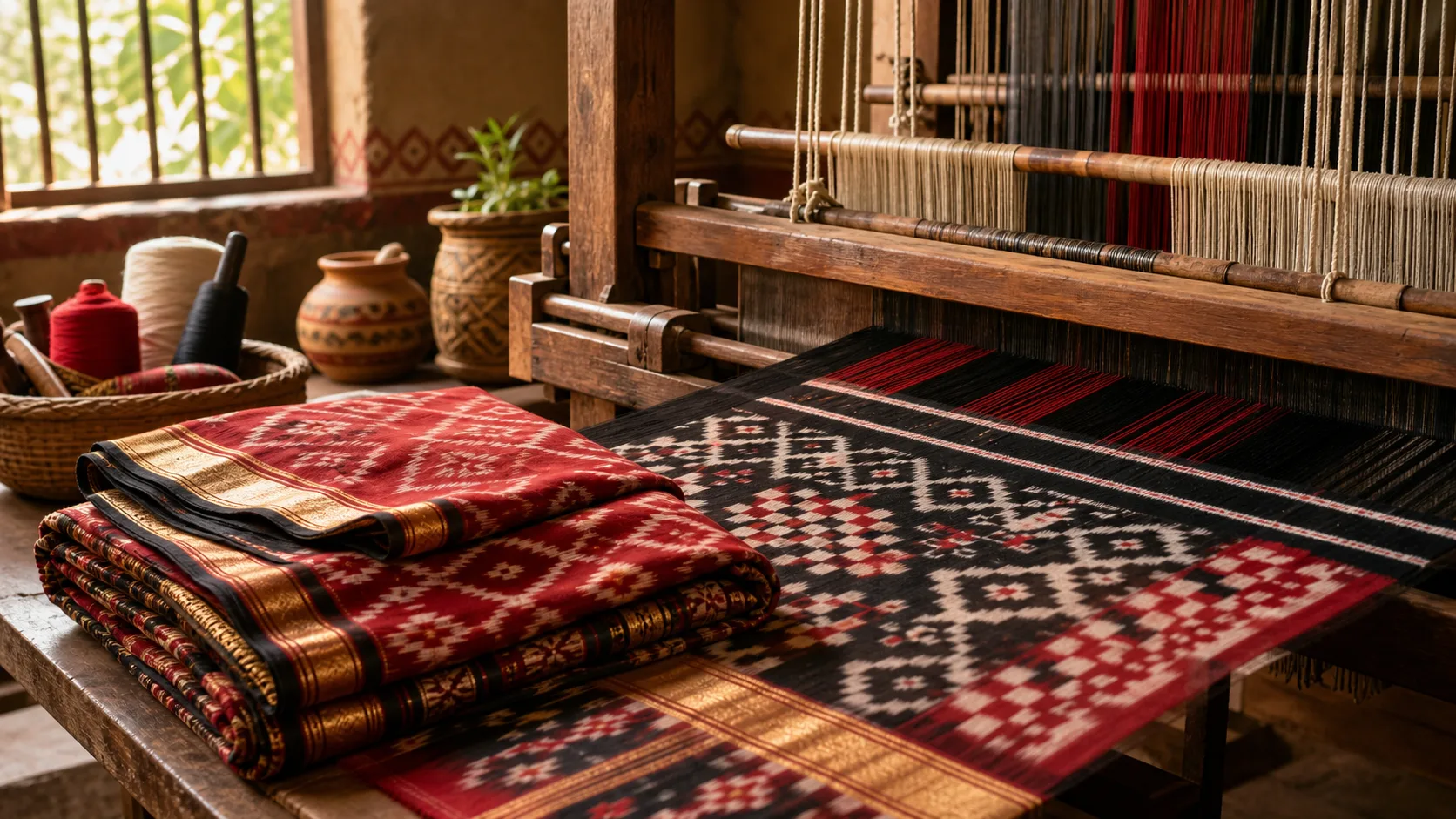
If you are buying a Sambalpuri saree online, the hardest question is simple: is it really handloom?
Sambalpuri sarees are among Odisha's most loved textiles, but their popularity has also invited printed imitations and machine-made lookalikes. A genuine Sambalpuri saree is not just a pattern on cloth. It is a resist-dyed textile where the yarn is tied and dyed before weaving, a technique locally associated with bandha and widely known as ikat.
1. Check the Reverse Side
The fastest test is the reverse side. In a real Sambalpuri ikat saree, the motif is woven into the fabric, so the back will show the design too. It may look softer than the front, but it should not be blank.
Printed copies often look sharp on the front and flat or faded on the reverse. If the seller shows only one glossy front-facing image, ask for a reverse-side photo before buying.
2. Look for Ikat Feathering
Real ikat has a slight feathered edge where dyed yarns meet. This is not a defect. It is part of the beauty of resist-dyed yarn.
Be cautious if every motif edge looks perfectly laser-sharp. That can indicate a digital print or powerloom copy.
3. Feel the Texture
Handloom fabric has a living texture. It may show small irregularities in the weave, slubs in cotton, or gentle variation in thread tension. Machine-made fabric often feels overly uniform.
If you cannot touch the saree before buying, zoom into close-up images. Look for thread structure rather than only color.
4. Understand Common Motifs
Sambalpuri sarees often use motifs such as:
- Shankha, or conch
- Chakra, or wheel
- Phula, or flower
- Pasapali checks
- Deer, fish, elephant, and temple-inspired borders
A seller who can explain the motif, weaving cluster, fabric, and approximate making time usually inspires more confidence than one who lists only color and price.
5. Ask These Questions Before Buying
- Is it handloom or powerloom?
- Is it silk, cotton, or silk-cotton?
- Can you share a reverse-side image?
- Which weaving cluster or cooperative is it from?
- Does it carry any handloom mark, GI reference, or weaver information?
- What is the return policy if the saree is not as described?
Red Flags
Avoid listings that use vague phrases such as "Sambalpuri print" while also claiming handloom. Also be careful with unusually low prices for silk pieces, product photos that look heavily edited, or sellers who cannot provide close-ups.
Final Buying Rule
An authentic Sambalpuri saree reveals itself in the yarn. The design should feel woven, not printed; human, not mechanical; rooted in Odisha, not merely styled after it.